As a maintenance manager, one of your most important priorities is to keep production running safely and efficiently. Unscheduled maintenance can lead to lost operating hours and productivity, additional costs for paying employees during downtime and more.
With help from preventive maintenance cost savings, maintenance managers can avoid the hefty price tag and operational setbacks associated with reactive repairs.
We’re here to explore what unscheduled maintenance costs and highlight how maintenance managers can adopt a preventive approach to improve operational efficiency, ensure a safe environment and keep maintenance budgets in check.

What is Unscheduled Maintenance?
Unscheduled maintenance, also known as reactive maintenance, refers to repairs performed after equipment has failed or broken down. It’s unplanned and often requires emergency labor, expedited parts and unplanned downtime, which significantly increases total maintenance costs.
Direct & Hidden Costs of Unplanned Downtime
Unexpected machine breakdowns have several negative financial impacts on your facility.
Initially, there’s the direct cost of lost operating hours as machinery stands idle and halts production. Beyond the immediate loss of productivity, businesses face the additional burden of paying employees who are unable to work effectively due to equipment failure.
Then you get hit with the extremely high emergency repair bill. These repairs, typically more costly than scheduled maintenance, can significantly impact your maintenance budget. Additionally, the lost productivity might necessitate overtime pay, extended operating hours and other costly measures.
The cumulative cost of unscheduled maintenance is far higher than the initial repair bill, making a strong case for the importance of preventive maintenance vs reactive maintenance strategies.
Preventive Maintenance: What it is & How it Saves Money
Preventive maintenance involves regular, scheduled checks and servicing of equipment to prevent unexpected failures. This proactive maintenance approach is designed to keep machinery running efficiently and avoid the disruptions of unplanned downtime.
By regularly replacing parts before they fail and performing routine maintenance, businesses can reduce the likelihood of emergency breakdowns and extend the lifespan of their equipment.
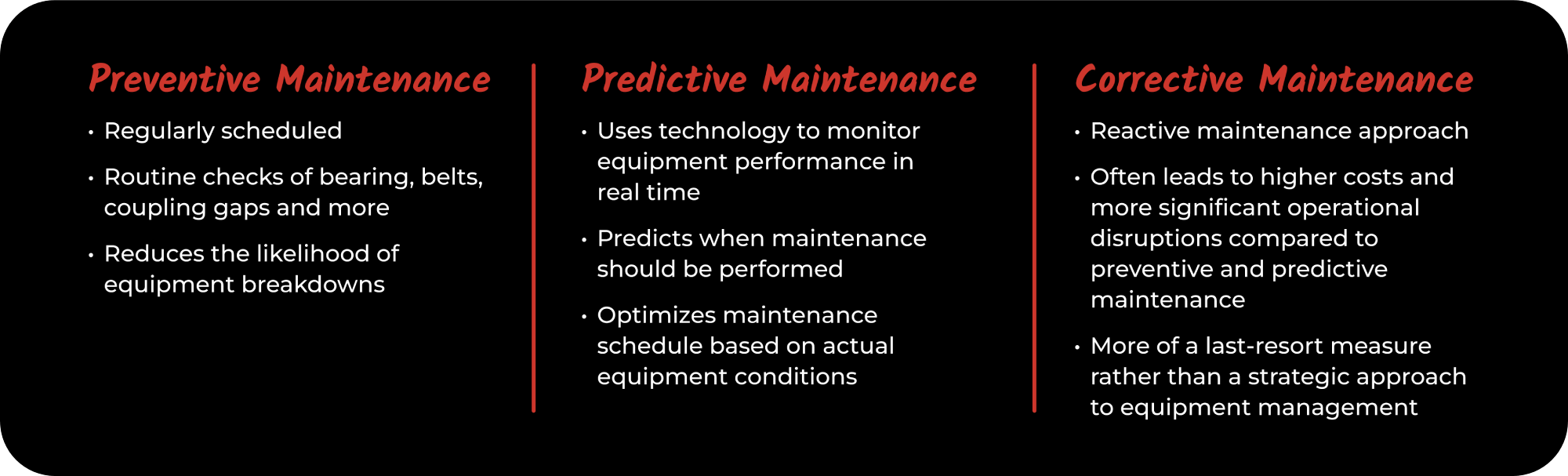
Preventive vs. Predictive vs. Corrective Maintenance
Preventive Maintenance
- Regularly scheduled
- Routine checks of bearing, belts, coupling gaps and more
- Reduces the likelihood of equipment breakdowns
Predictive Maintenance
- Uses technology to monitor equipment performance in real time
- Predicts when maintenance should be performed
- Optimizes maintenance schedule based on actual equipment conditions
Corrective Maintenance
- Reactive maintenance approach
- Often leads to higher costs and more significant operational disruptions compared to preventive and predictive maintenance
- More of a last-resort measure rather than a strategic approach to equipment management
Cornerstone Mechanical can assist in developing a custom plan centered on preventive and predictive maintenance to decrease the need for frequent emergency corrective maintenance.
How to Avoid Unplanned Downtime
- Schedule regular inspections
- Use sensor-based monitoring
- Maintain an inventory of spare parts
- Train operators to avoid misuse and early wear and tear
Partnering with Cornerstone Mechanical for preventive maintenance ensures your rotating equipment runs smoothly and reduces the likelihood of emergency shutdowns. Call our team at (214) 225-7038 to schedule your preventive maintenance today.